I am ending this site. I enjoyed posting the latest astronomy news, and discussing astronomy topics that are not very popularized. I hope everyone appreciated my effort as much as I enjoyed your visits. This site was just taking too much of my time. This site has given me a lot of insight to other websites where they work almost non-stop. Because I did everything on this site own my own watch, I might look for an online writing position at some kind of astronomy site (I would love to be contacted here).
From here, I say good-bye, maybe when I have more time I'll open up the shop again, but for now, thank you.
To all of my daily visitors and subscribers, I would like to forward you to my absolute favorite astronomy site, Universe Today by Fraser Cain: and along with Dr. Pamela Gay, their weekly podcast Astronomy Cast.
And if you have any last-time comments, feel free to email me at the email above.
Thursday, August 9, 2007
The End of Astroversity

Carnival of Space 15
Dr. Pamela Gay is hosting this week's exciting Carnival of Space. I enjoyed it, and you will to.
Wednesday, August 8, 2007
Do You Really Know What NASA Is?
When most people think of NASA, they either think of the space shuttle, or the two Mars rovers. What the majority of people don't know is that NASA is not just one large building in Florida where they build, plan, and research everything on their agenda. NASA is like a tree with many branches. There are many different divisions and branches each specialize in something. Some cohorts research, while others may be construction, test, or administrative facilities.
I will just give you a brief summary of 5 of NASA's 'branches' and then I will direct you to other 'branches:' Kennedy Space Center - The KSC is home to the three space shuttles. This is where they are stored, maintained, and repaired. The center is also a very popular tourist location to view space launches and tour the location. The KSC is most familiar to people because it is where space shuttles (and other orbital spacecraft) are launched from. As NASA puts it, "Kennedy Space Center is America's Gateway to the Universe."
 Jet Propulsion Laboratory - JPL is located in La Cañada, California. JPL is managed by the California Institute of Technology (Caltech). JPL is NASA's main source of robotic vehicles sent into space. Some of the unmanned spacecraft by JPL include: Voyager 1, Voyager 2, Mars Rovers (Spirit & Opportunity). Spitzer Space Telescope, Mars Phoenix Lander, and many more.
 JPL, instead it is more study based. Goddard's missions is to study Earth, the Solar System, and the Universe as a whole to further increase man's knowledge of the Universe. Goddard's main study approach is through observations.
 Dryden Flight Research Center - Dryden represents the 'A' (the first one) in NASA. Dryden is where the world's "...newest, fastest, [and]... highest," debut. Dryden is at the forefront in aeronautical research and performance. They have helped to create some of the world's most advanced aircraft and have applied their knowledge to space technologies.
 Marshall Space Flight Center - The Marshall Center do a large variety of things. The Marshall Space Flight Center is mainly a propulsion center. They construct propulsion technologies such as rockets, Space Shuttle propulsion, and the external fuel tank. The MSFC also manages various scientific activities aboard the International Space Station. They utilize space research and apply them to life here on Earth for the benefit of people all over the world.
I just offered a small bit of what NASA really is. The underlying purpose of this article is for you to understand that NASA is not a single installation, but instead a group of many facilities all over the U.S that help NASA to do everything that NASA does.
To learn more about the different NASA centers, visit this list. And to visit the sites of NASA's major centers, go here.
Image Credits: Wikimedia & NASA
Tuesday, August 7, 2007
Space Exploration Is Important!
In discussion, the topic sometimes arises to question the importance of space exploration and NASA. Explaining the importance of NASA over an over again can sometimes lose its meaning. Today, I came upon a very good article by Neil deGrasse Tyson [via Bad Astronomy (thanks for the post!)] explaining why America needs to continue space exploration.
According to the article, NASA is only .7% of the federal budget. Compare this to the $12,000,00o that is spent in Iraq every hour! NASA is a cause that actually provides a beneficial outcome, airplanes, plastics, communication, and the list goes on!
I highly recommend you read Tyson's article, and also read commentary provided by Phil Plait.
Monday, August 6, 2007
As the Space Shuttles Age...

NASA originally decided that when astronauts would return to Earth (Using Orion Spacecraft), the space vehicle would use air bags to land on the ground. NASA and their contractor Lockheed Martian have decided to scrap that concept and go back to using an Apollo-style landing by splashing into the oceans. This will cut weight of of the mass and in turn, cost less.
Because all three space shuttles will be retired, NASA has already made plans for the three Orbiter Processing Facilities to be demolished between 2010 and 2012.
Original Article: NASA Spaceflight
Thursday, August 2, 2007
Carnival of Space #14
This week's Carnival of Space has rolled into Universe Today. I just checked it out and found a lot of interesting articles. You'll enjoy this week's large variety, so go check it out!
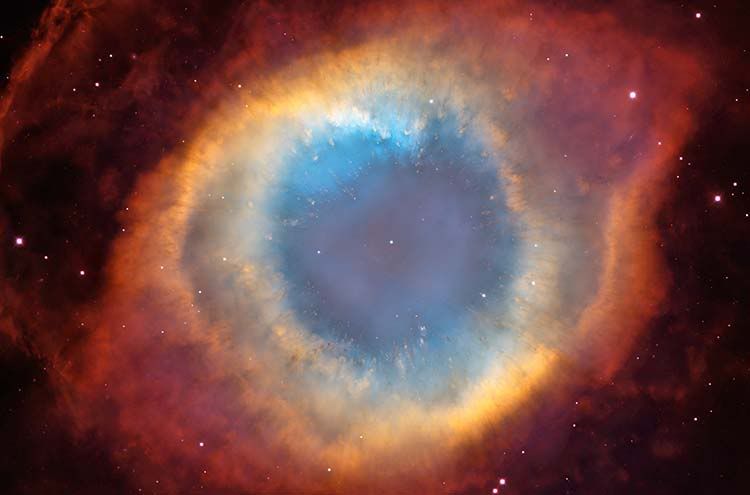
Best of Hubble: Nebula & Space Gas
The Best of Hubble Image Series theme today, is featuring various Nebula & Space Gas. I received a LOT of submissions. I had a very difficult time choosing the best, but I went with the images that were nonimated multiple times by different people. So here they are:
Image Credits: Hubble.




Tuesday, July 31, 2007
Explained: Why Pluto Is Not A Planet
 In August of 2006, the International Astronomical Union (IAU) made a textbook altering decision. The IAU is the main naming and definition-making organization in the astronomical community. After much debate and discussion, scientists at the IAU meeting collectively decided that Pluto's planetary title would be removed, and it would be labeled as a dwarf planet.
While some people applaud the IAU's decision, others refuse to accept it. The decision was made in 2006, and although people know Pluto is not a planet, most people fail to understand why Pluto is not a planet.
 The common belief is that the IAU simply stripped Pluto's planet status. However, in reality, the IAU just issued a new set of requirements that would define if an object were a planet or not. Pluto failed to meet these new requirements. Pluto is not a planet because it does not meet all of the criteria that it takes for an object to be labeled as a planet.
The IAU stated that a celestial body must meet the following conditions to be called a planet:
- Orbits the Sun - The object should be orbiting the Sun. It cannot be orbiting another planet, or another object. It can only be a satellite of the Sun.
- Be a sphere - The object's 'self-gravity' should be strong enough that it smooths out any (major) bumps or ridges to become a mostly spherical body.
- Cleared its orbital neighborhood - There should not be any other bodies in the object's orbit. During the object's formation, it should have absorbed and cleaned out any debris in its orbit (with the exception of moons, because moons are gravitationally 'caught').
- Compared to Pluto, Pluto's moon Charon, is pretty large because it is only about half Pluto's size. Both objects orbit a common center of gravity, but Pluto orbits this center of gravity at a much close distance than Charon, so that's why Charon is considered Pluto's moon.
- For every three times Neptune orbits the Sun, Pluto orbits it only twice. This is called a 3:2 orbital resonance. In addition, there is a whole category of objects that do exactly this; they're called Plutinos. Pluto is also a Trans-Neptunian Object (TNO) and these objects orbit the Sun at a farther distance than Neptune does.
- Pluto is also on the borderline of a region in our Solar System known as the Kuiper Belt where many icy bodies (both big and small) orbit the Sun at a very large distance.

Image Credits: IAU, The IAU Votes; NASA, Pluto's newly discovered Moons; Wikimedia, the New Solar System.
Additional Resource: AstronomyCast: Pluto's Planetary Identity Crisis (Why Pluto isn't a planet)
Monday, July 30, 2007
Announcement
Astroversity originally started out as an astronomy site where you could get the latest in space/astronomy news. Although I will still provide important news, I won't be reporting all of the news. This in effect is going to steer this site so it is more helpful and interactive with the daily visitor.
Like I said news won't be the main objective of this site, but if you're looking for astronomy news, visit my favorite website Universe Today where Fraser Cain is always reporting the latest.
Sunday, July 29, 2007
Best of Hubble: Galaxies
The first edition of the Best of Hubble Image series will be Galaxies. When viewing the images, like I always say, my layout does not reveal the true beauty of these images, so click on them to view a hi-res version of the image. To learn more about the selected images, click its corresponding name at the bottom. The subject of the next set of images will be pictures that feature nebula (start sending in your favorites). Many of you submitted your favorite galaxies and here they are:
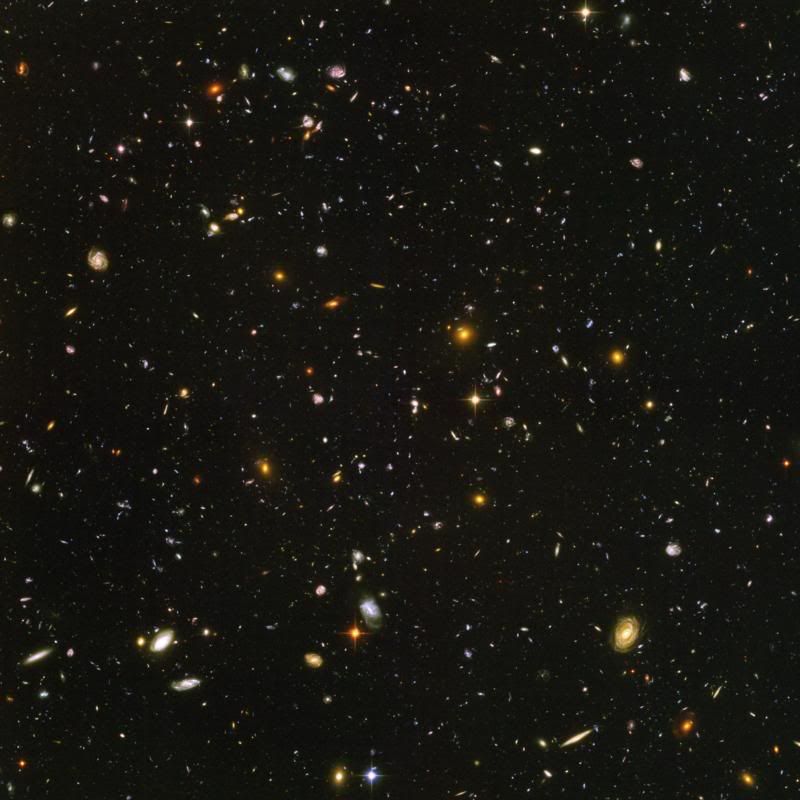


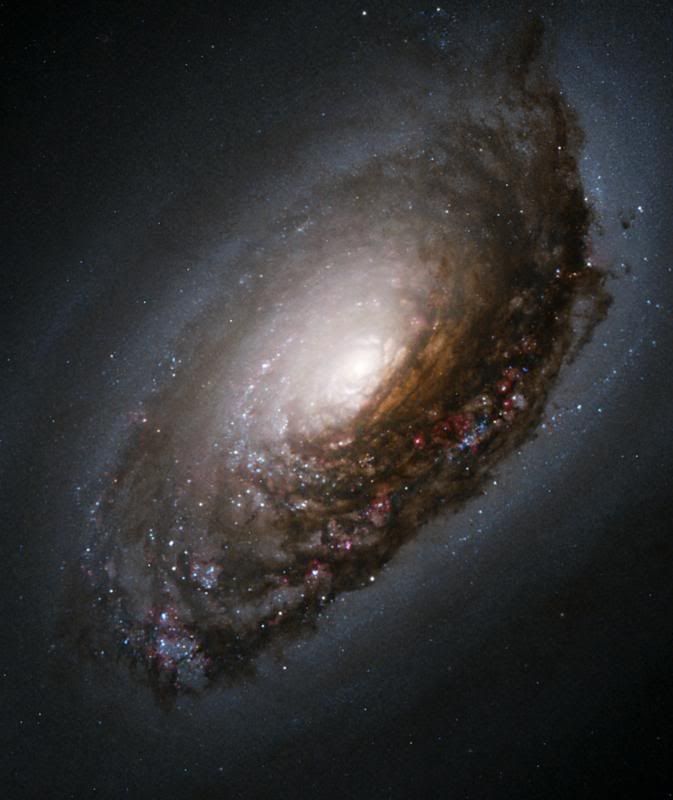
Image Credits: Hubble. Images in order: M51, NGC 1300, NGC 4038-4039, Hubble Ultra Deep Field, Hoag's Object Galaxy, M64
Perseid Meteor Shower
The annual Perseid meteor shower will rain in the sights of sky watchers all on the Earth in two weeks on August 12. The best part of all is that there is a new moon on the 12th, meaning there will be no moonlight to obscure the view of the meteor shower.
The meteor shower is credited to the Comet Swift-Tuttle. Every year in August, the Earth moves through the debris left by the Comet's tail as it passes through our orbit. The small bits of the comet collide into the Earth's atmosphere at a whopping 132,000 mph so even the smallest objects light up in the sky. Above: A Perseid fireball photographed August 12, 2006, by Pierre Martin of Arnprior, Ontario, Canada
The meteor shower starts at 9:00 to 10:00 on the 12th in the northeast(your local time) and you may see a a couple during an hour of sky watching. At the night unfolds, so will the amount of meteors. At around 2 AM of the 13th (still your local time) there may be dozens of meteors every hour. Bill Cooke of NASA's Meteoroid Environment Office estimates that at the shower's peak (before dawn), there will be one or two Perseids every minute.
Mars will also be observable. It will look like a bright red star in the northeast.
For optimal viewing of the meteors, it is best to be somewhere in the country or small suburbs where light pollution is not much of an interference.
Original Article: NASA
Friday, July 27, 2007
My Favorite Space Images
These are some of my favorite space images. Not all of the below pictures are taken by hubble. The compressed images below do not do these images the justice they deserve, so just click on them to view a higher resolution version of the picture. (The first three make good desktop backgrounds). Images: Mars, M51, NGC 6357, Saturn, Carina Nebula.
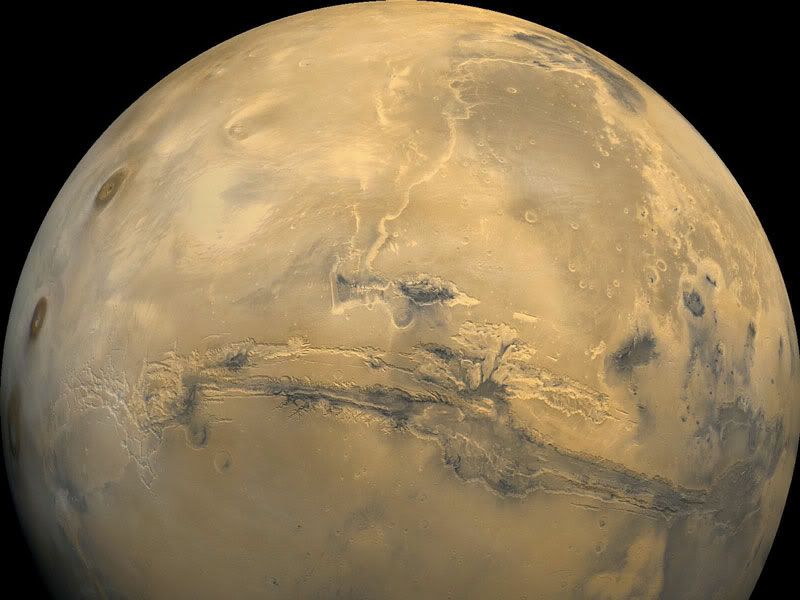
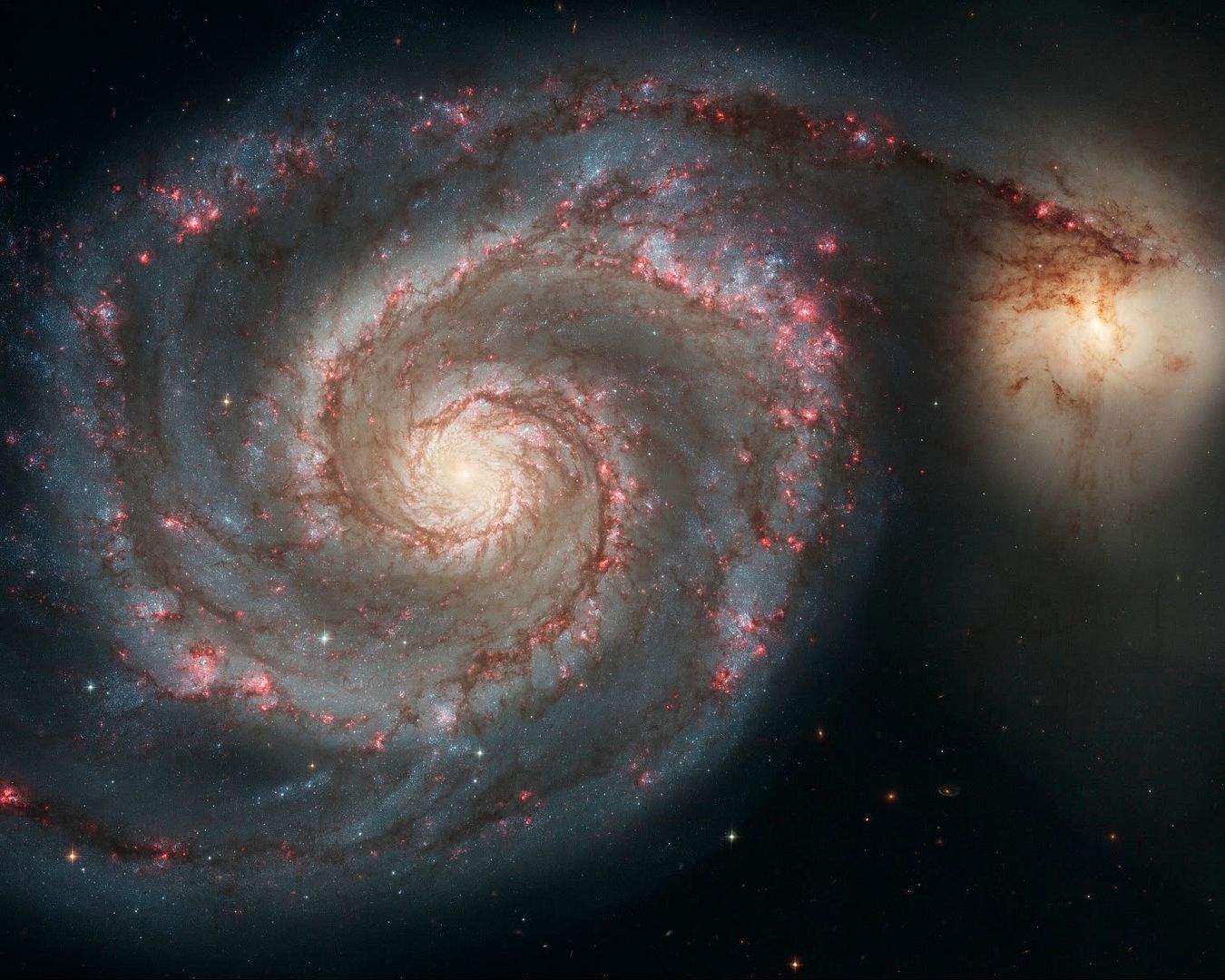
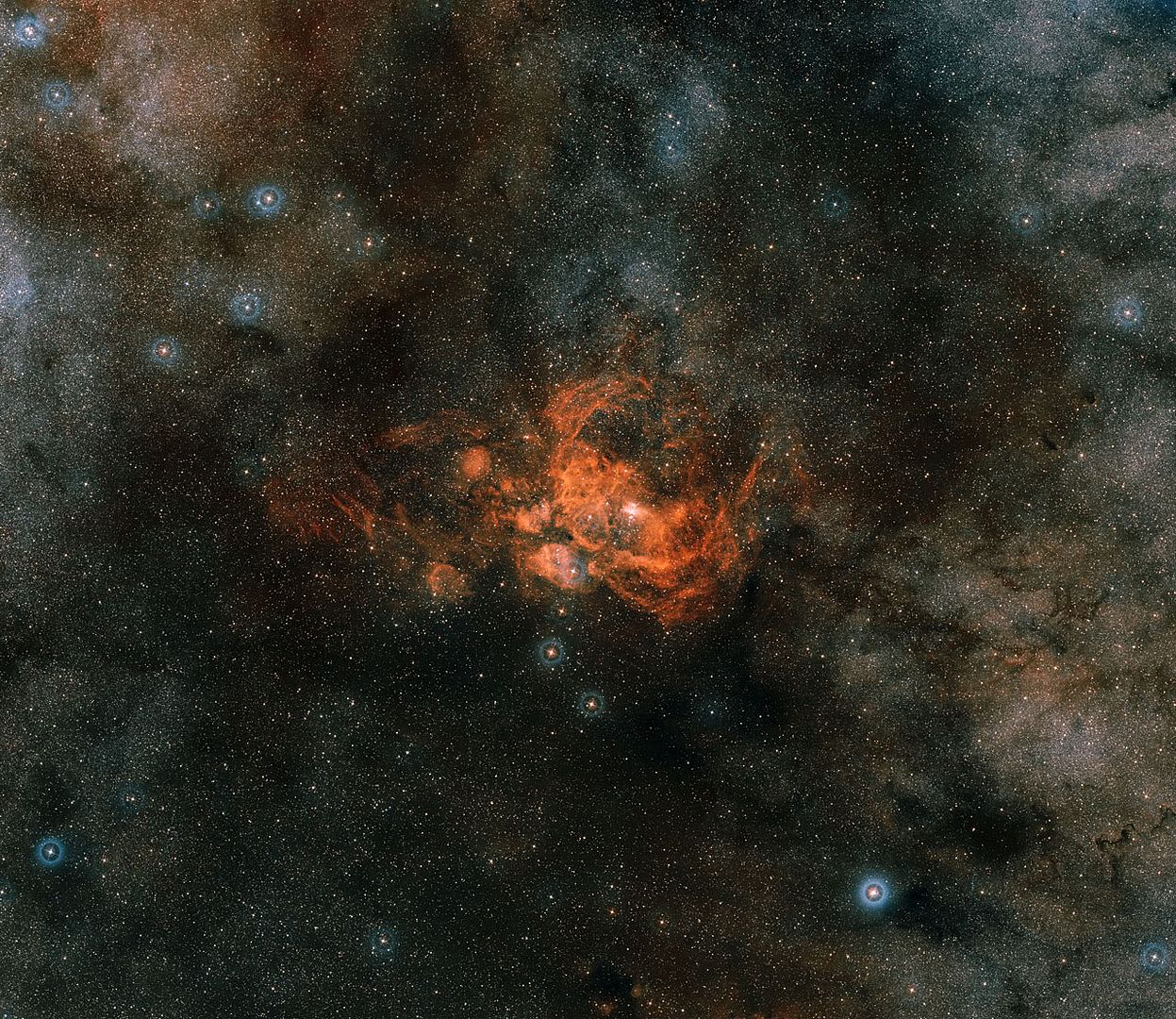


Just a head's up, my first feature of Hubble images are going to be galaxies. So send in your suggestions and favorites of galaxy images that the Hubble has taken (email is located at the top right).
Carnival of Space 13
This week's Carnival of Space is being held at the LiftPort Blog. Give it a visit. Read about astronomy, and get to know a couple of new sites.
Thursday, July 26, 2007
The Best of Hubble Series
I'm going to start a series entitled, "Best of Hubble" in which I will feature the best of a certain type of Hubble image. So one theme might be "Best Nebula Images," or "Best Images From Our Solar System."
Pictured: The Hubble Space Telescope. Image Credit: NASA
I want to let everyone know that I cannot do this alone. I will be accepting suggestions for each theme. I will let you know in advance what kind of images I'm looking for, and then you can suggest them to me. My first of the Hubble Image Series will not be all Hubble images. They will just be a few of my all-around favorite space pictures. Be on the lookout for that, and I will be anxious for all of your help!Mars Rover Dust Storm Update

Pictured: Opportunity's view, as the horizon becomes more opaque every day. Image Credit: NASA
Where is today's Carnival of Space 13?
I'm always saying how much I enjoy the weekly Carnival of Space. But this week's edition seems to be missing! Both the official blog carnival website and the Carnival of Space schedule say it is supposed to be today at the LiftPort Blog, but it is not. There is a post on their blog that says they only received six entries, but that still means there were entries. So what happened? I'm just confused.
News From Around the Block
 There has been a lot of astronomy news lately, so here it is:
The Chandra X-Ray Observatory has discovered, 'piranha' black holes that that voracious eaters and seem to go away. Chandra catches ‘piranha’ black holes
Our Sun goes through a solar cycle, and the Sun is currently reaching the apex of one of them. The Sun Loses its Spots
It's possible for a planet to have the remarkable view of four sunsets by its four parent stars. Quadruple Sunsets Possible on Other Worlds
A plan to send a robotic mission to Mars which could send back some surface samples are causing a stir and debate between NASA scientists. Mars-and-back plan sets scientists abuzz
Image Credit: NASA. Pictured: A potential Mars sample-return mission.
Tuesday, July 24, 2007
Fantastic Guide to Learn About the Stars
I am very familiar with the many astronomy concepts of the Universe, but I know absolutely nothing about stargazing. I discovered a fantastic interactive guide, which will give anyone who goes through it a very basic understanding about watching the stars.

Whenever I look up at the night sky (Chicago lights diminish the experience), I am always awed by the dim specks of light, and the infrequent visits of planets in my night sky. However, to actually understand what I am looking at, and how I can use the stars to my advantage is something I did not really know how to do.
By the end of the guide, you will be familiar with many different things, and will be able to identify:
- 3 Constellations
- 2 Stars
- 1 (or more) planet
- And the useful ability to use the stars as a natural compass
This excellent feature allowed me to learn about the stars in such a simple way. I never thought understanding the stars could be such an easy experience. I give this feature five stars (
(no pun intended).
Original Article: From LifeHacker, From Hackszine
Monday, July 23, 2007
Mars Rovers Dust Storm Upadate

Sunday, July 22, 2007
It's Important to Capitalize in Astronomy
I understand it is fairly simple to write something like, "The sun is at the center of the solar system." But I just feel those are large errors to commit when writing. Again, both the Sun and Solar System are proper nouns so they should automatically be capitalized.
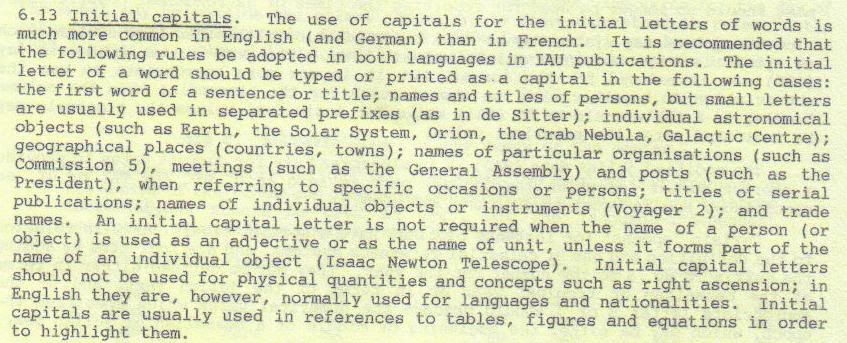
The International Astronomical Union (IAU), which is the official authority on naming celestial things, the structure of astronomical papers, and astronomical grammar, does not have the authority to fully demand capitalization all the time. Different countries have different rules in remarks to their grammar. The IAU Style Manual states, "The use of capitals for the initial letters of words is much more common in English (and German) than in French," but they do recommend that astronomical objects should be capitalized in both languages.
This is what the IAU recommends in reference to astronomy capitalization, "The initial letter of a word should be typed or printed as a capital in the following cases...individual astronomical objects (such as Earth, the Solar System, Orion, the Crab Nebula, Galactic Centre)...[and] names of individual objects or instruments (Voyager 2)."
I just wanted to address this because it is important to capitalize the Andromeda Galaxy just as its important to capitalize the White House. I am not going to end on a note saying thay, "To keep astronomy sacred and precious we must first correct our grammar." All that I am going to say is just capitalize those astronomical objects because all things in astronomy are wonders, are proper, and are worth the extra effort to be capitalized.
Afterthoughts:
- Is it just me, or did I say 'astronomical objects' a lot?
- I noticed that major writing applications such as Word, Open Office, and other online spell-check features do not automatically capitalize astronomical objects.
- I recently discussed astronomical capitalization with Helium.com and since then, they have changed most of their space-related articles so words like the Sun and Solar System are capitalized.
- The IAU does not say anything about capitalizing astronomical objects that are plural
Links:
IAU Recommendation of Spelling (Online)
IAU Full Recommendation of Capitalization (In Print)
